

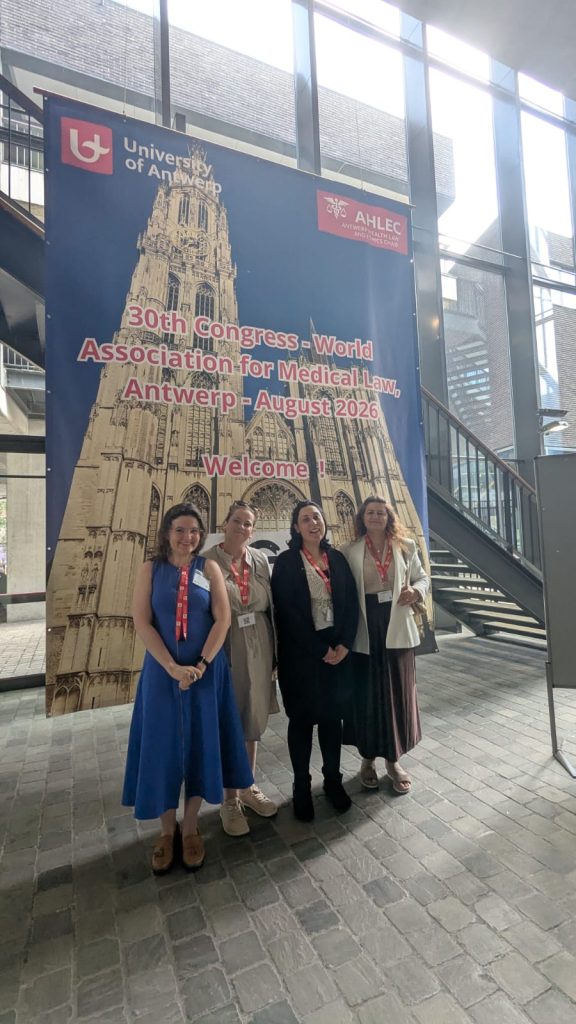
From 5 to 7 August 2026, researchers from the Health Law Research Centre at Lund University participated in the 30th Annual World Congress for Medical Law in Antwerp, Belgium. Organised by the World Association for Medical Law, this year’s congress took place under the theme Expanding Boundaries of Health Law: Access, Innovation and Interdisciplinarity. The theme provided a fitting setting for three contributions from Lund, each concerned with an area in which established legal frameworks are being tested by developments in technology, public health and biomedicine.
Across the three presentations, a recurring question was how law should respond when new practices develop faster than the legal frameworks and categories through which they are regulated. The topics were quite different: commercial large language models in clinical practice, AI-supported disease surveillance, and heritable human genome editing. Yet, each presentation raised questions about the scope of existing rules, the allocation of responsibility, and the ethical and normative values that should guide legal development.
Commercial LLMs in clinical practice
Ana Nordberg, Petra Holmberg and Sarah de Heer presented research on the integration of commercial large language models (LLMs) in clinical practice. Their work examines the increasing use of general-purpose AI systems in health-related settings and asks whether existing EU legal mechanisms provide adequate protection when such systems acquire functions that resemble medical services.
The point of departure is a practical regulatory difficulty. Commercial LLMs may be used by patients as sources of health information and may also enter hospitals, e-health platforms and other healthcare environments. Their use can gradually extend beyond the purpose for which a system was originally designed. The researchers describe this as “function creep”: general-purpose systems begin to perform functions with medical relevance without necessarily being formally recognised or certified as medical devices.
Their analysis brings together several areas of EU law, including medical device regulation, consumer protection, contractual liability, data protection and public procurement. The preliminary findings identify uncertainty about where responsibility lies when LLMs are incorporated into healthcare practice. Questions also arise concerning hallucinations, explainability, automation bias, health profiling and the use of disclaimers that may shift responsibility towards patients or healthcare professionals.
The presentation and their forthcoming paper therefore consider a problem that is becoming increasingly important for health law: how legal responsibility and quality assurance should be organised when systems developed for broad commercial use become part of healthcare practices.
Disease surveillance and the boundaries of the EU AI Act
A second contribution, by Yana Litins’ka and Petra Holmberg, examined AI-driven disease surveillance and the scope of the EU Artificial Intelligence Act. Their research focuses on two exemptions in the Act that may be especially relevant in this area: national security and scientific research.
Disease surveillance can serve several purposes at once. It may contribute to public health preparedness, public security and, in some circumstances, national security. Universities and other public research actors may also develop or test AI systems that later become useful to public authorities. This creates difficult questions about when an activity remains within the sphere of research and when the use of a system or its outputs becomes part of administrative decision-making.
The researchers argued for a narrow interpretation of both exemptions. In their analysis, the national security exemption should not remove disease-surveillance systems from the AI Act merely because national security is one of several interests involved. Similarly, the research exemption should have limits when AI systems or their outputs move beyond scientific work and are used to support public-health or administrative decisions.
This approach draws attention to the purpose for which an AI system is actually used. It also highlights the importance of preserving the safeguards of the AI Act when cooperation between universities, researchers and public authorities leads to operational applications.
Reconsidering the foundations of EU rules on heritable genome editing
Jessica Almqvist presented research on the regulation of heritable human genome editing (HHGE) in the European Union. Her contribution starts from the fragmented international legal landscape surrounding interventions that may introduce genetic changes capable of being inherited by future generations.
International and European instruments have long reflected a restrictive approach to the clinical use of HHGE. The abstract points, among other examples, to Article 13 of the Council of Europe’s Oviedo Convention and to the EU Clinical Trials Regulation, which prohibits gene-therapy clinical trials resulting in modifications to a subject’s germ-line genetic identity. At the same time, the broader international context is developing. Changes in national approaches, private investment in gene-editing technologies and the EU’s own ambitions in biotechnology create reasons to revisit the normative foundations of the existing European position.
Using a normative and value-oriented methodology grounded in European human rights law, the presentation centred on human dignity and human equality, as translated into a ban on eugenic practice and solidarity between generations. The presentation’s central question revolves around what a sound EU policy towards HHGE should be in a legally fragmented environment, marked by the unequal distribution of power, and whether the current restraint towards HHGE can be justified on grounds that remain persuasive amid growing economic interests in biotechnology.
The presentation therefore places the future of gene-editing regulation within a wider discussion about the principles that should guide European biotechnology policy. As scientific capabilities develop in an economically driven environment, the legal debate will also have to articulate and reinforce the normative reasons for maintaining, revising or further specifying existing limits.
A shared concern with regulatory boundaries
Taken together, the three contributions illustrate several strands of research currently pursued within the Health Law Research Centre. They range from technologies already being used by individuals and healthcare organisations to forms of biomedical intervention whose future clinical use remains highly contested. In each case, specific legal analysis engages with broader legal questions of classification, institutional responsibility and the relationship between innovation and fundamental rights.
The Congress offered an opportunity to discuss these questions with researchers and practitioners working across health law and bioethics in different jurisdictions. Its broader programme included themes relating to equitable access to healthcare, technology and legal innovation, and the intersections between health law and other areas of law.in
For the Health Law Research Centre, participation in the World Congress for Medical Law at the University of Antwerp also provided an opportunity to place ongoing Lund Health Law research in an international conversation. The discussions around these three projects will continue as the underlying technologies, regulatory frameworks and legal debates develop.
